NeuroSDR — What it is (hardware SDR first, AI where it helps)
Hello. This is KD8CEC.
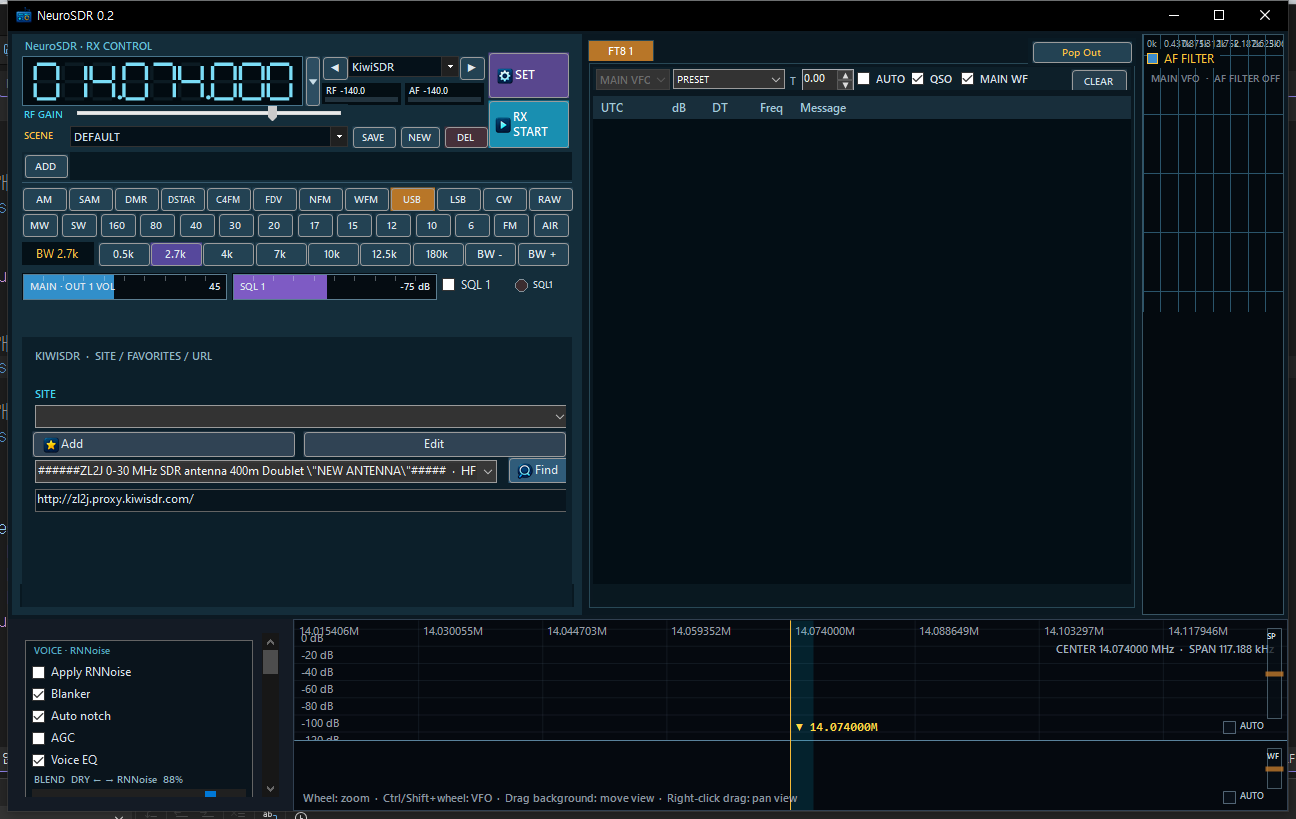
NeuroSDR is a Windows software-defined radio receiver. The primary job is simple to state and hard to do well: take IQ from a real SDR, show a usable spectrum/waterfall, demodulate cleanly, and keep decoding plugins running while you still listen.
I publish release zips so most people never compile anything: NeuroSDR Releases.
1. Why I built it this way
There are already good SDR programs. What I wanted on my desk was:
- Wide capture + many receivers at once — On something like an SDRplay RSP with several megahertz of instantaneous bandwidth, park MAIN on a shortwave broadcast or CW, while Sub VFOs keep decoding FT8 (or other AF plugins) on other dial frequencies inside that same window. That multi-receiver idea is one of the founding goals (see the RSP1 / Sub VFO video below).
- A full radio surface — Modes people actually use (AM/SAM/NFM/WFM/USB/LSB/CW/RAW/FreeDV, plus digital voice), dual audio outs, AFC, recording, memory/scan, SCENE layouts, satellite Doppler tracking.
- AI where audio is hard — Live captions/translation (NeuroCaption), RNNoise voice extraction, and speech-oriented scan helpers — without turning the app into a “demo that only works on YouTube.”
Design, coding, docs, and GitHub maintenance are driven by AI agents (Grok). I review, test on real radios, and ship the releases.
2. What is different from “another waterfall”
| Area | What NeuroSDR does |
|---|---|
| Hardware first | Native paths for SDRplay, RTL-SDR, HackRF, Airspy, Airspy HF+, SoapySDR, rtl_tcp. Sample-rate / AGC / amp options live under SET → RF / Performance. |
| Sub VFO | Independent virtual receivers inside the capture window; AF plugins attach per VFO. |
| SCENE | Named working sets: source, plugins, Sub VFOs, view, pop-outs — including a Satellite scene with Doppler-aware tracking. |
| NeuroCaption | AF plugin for speech-to-text + optional translation (local ONNX/Sherpa Whisper, Groq API, or self-hosted Whisper). |
| AF / IQ plugins | FT8/FT4, CEC CW, SSTV, RTTY, weather fax, Kiwi helpers, digital-voice bridges, ADS-B-style IQ paths, and more as instances. |
| AF hygiene | RNNoise blend, AF bandpass, active CW filter, dual OUT1/OUT2 (e.g. speakers + VB-CABLE → WSJT-X). |
| Digital voice | DMR / D-STAR / C4FM via embedded DSD-FME path with dedicated feed AGC/volume. |
| Optional remote sources | Virtual WebSDR / KiwiSDR / OpenWebRX when you want Internet RX without a dongle. |
| Optional web remote | Browser/phone UI when enabled in SET → General (video for this path is still forthcoming). |
3. AI captions (NeuroCaption) — real feature, not a sticker
NeuroCaption is an AF plugin. It listens to demodulated audio from MAIN or a Sub VFO. You pick an engine in Caption SETUP:
- Local ONNX (Sherpa Whisper INT8 Tiny/Base/Small) — offline
- Groq API — fast cloud Whisper when you have a key
- Self-hosted Whisper — your own GPU/server
Optional MyMemory translation puts foreign shortwave speech into a language you can skim while still hearing the RF.
4. About Virtual WebSDR / Kiwi (secondary)
Episode #2 on YouTube walks Kiwi/WebSDR for people with no hardware yet. That path is useful for travel, apartment antennas, or trying captions on HF overnight — but it is not why the Sub VFO / wide-band FT8 design exists. Wide simultaneous decode needs hardware instantaneous bandwidth.
- This post — concept (hardware first)
- Download + hardware install (RTL-SDR / Zadig, SDRplay API, …)
- Basic operation manual
- NeuroCaption & AF plugins
- Advanced: Sub VFO / FT8 / satellite / digital voice / Smart Record / web remote
NeuroSDR — KD8CEC · Blog: https://www.hamskey.com · Downloads: GitHub Releases · Source: github.com/phdlee/NeuroSDR
Comments
Post a Comment